« December 2007 | Main | February 2008 »
January 2008 Archives
January 4, 2008
Happy New Year
I'll admit that I didn't (and don't) understand the article's first line: "For Christians--and many Muslims--the main reason to celebrate this Christmas is, of course, Jesus' birth." I wasn't aware that Muslims did that. If so, I feel confident that they're not celebrating the same Jesus as the rest of us, but I mention it only because it seems an odd preface to the persecution of Christians, which the adherents of Islam in certain places are eager to inflict.
The Weekly Standard can be a mixed bag of varying conservatisms, but in this season of Merry Christmas and happy New Year, of personal resolutions and of hope for increased prosperity, the reminder that Paul Marshall offers in the current issue - that Christmas is not, for everyone everywhere, an event of unblemished joy, but one fraught with peril - should for us be salutary.
...for probably hundreds of millions, Christmas is shadowed by pain and fear, since this is usually the peak season for anti-Christian attacks in Pakistan, India, Sudan, Nigeria, and beyond. It is also a time when the Chinese and Vietnamese governments are prone to arrest their unregistered believers.
January 5, 2008
Money (In God We Trust)
Wither the Republican party in the aftermath of the Iowa caucuses? The party mandarins are aghast at the success of Huckabee, and talk radio personalities are excoriating their own listeners, on the grounds that, by supporting Huckabee, they have ceased to actually vote conservatively. While I am not predisposed to political prognostication, I believe that it would be instructive to spend a few moments analyzing the background to this apoplectic reaction to moderate doses of quite possibly toothless - as I have argued previously - populism. The issues implicated in the controversy, though superficially insubstantial (Huckabee appears to be a compassionate conservative in the mould of Bush, his deviations from GOP orthodoxy are marginal matters of emphasis in most instances, and those rhetorical tropes which have drawn criticism are too slight to merit the weight of the opprobrium they have elicited.), have precipitated a tipping of hands on the part of the custodians of Republican orthodoxy.
Consider the following contributions to National Review's Symposium on the Iowa Caucuses:
According to the Club for Growth, Huckabee takes “profoundly anti-growth positions on taxes, spending, and government regulation.” For Huckabee to succeed where Robertson and Buchanan failed, one of two things must happen. Either he must mislead GOP voters into thinking that he is an economic conservative, or those voters must stop caring. Either way, a Huckabee victory would be very bad news for conservatism as we know it. (John J. Pitney, Jr.)
Huckabee is a fringe Republican, and does not represent the conservative movement on economic policy, domestic programs, law and order, and foreign policy. It is hard to imagine a candidate so out of step with most in the conservative movement assuming the stage in Minnesota in eight months as its leader. (Pat Toomey, of the Club for Growth)
I'm uninterested in dwelling on the relative strengths and degrees of influence of the various factions which collectively comprise the GOP; we all know that the social conservatives are the base of the party and that the Wall Street types provide the bulk of the financing. There's nothing either novel or earth-shattering about such an observation. Rather, it is the philosophical presuppositions of these judgments that hold all of the interest; there's no sense in gesticulating towards a social formation unless one is willing, subsequently, to determine what that formation means, as a discourse. And the discourse of the GOP establishment is profoundly confused, and mistakes its mystifications for enlightenment.
January 6, 2008
Equality before the law
I admit to not having a precise and snappy definition of "equality before the law" in the sense in which I think equality before the law a good thing. For example, it seems to me legitimate that a child should receive a lesser sentence for some actions than an adult.
But I have a rough and ready notion of what is not equality before the law and what is, on those grounds, unjust. If I commit a crime and the evidence is excellent, but my cousin is a good friend of the judge, and if I get off with a light sentence because of that friendship, that is not equality before the law. If I commit vandalism and the police refuse to prosecute because I come from an influential family, that is not equality before the law.
Now most of us, myself included, would like to believe that this sort of equality before the law is part of what the American legal system is all about. We don't have aristocratic titles in America, and our ideal, our goal, is that people who commit crimes for which there is good evidence will be prosecuted regardless of their parentage, their profession, or their "pull" by way of friendship with people in high places.
The reality is rather different from the ideal. Reality usually is. And this seems to me to be a rather egregious example of inequality before the law. Or would have been, were it not for the blogosphere.
Living in the Idiocracy
A Pentagon analyst specializing in Islamic law has been removed from his position after coming into conflict with associates involved in outreach to the Usual Suspects, according to Bill Gertz. Andrew Bostom elaborates, and discusses an historical parallel, observing that the analyst, Stephen Coughlin, has demonstrated
...that “Jihad fi Sabil Allah”—“Jihad in the cause of Allah,” is the animating principle which underlies the threat of global jihad terrorism, and how this understanding should form the basis for rational, effective threat development assessment, and war planning.
Or, the actions of his superiors being interpreted, Coughlin was sacked because he apparently refused to practice historical revisionism, and presented jihad as an integral aspect of classical Islamic doctrine, and not some sort of false consciousness necessitating a non-Islam theory of Islamic extremism.
Further interpretative efforts will be eschewed, inasmuch as this contributor already believes that he has entered the Twilight Zone, or some parallel universe or strange dimension hidden within a 'fold' of space-time, within which the law of non-contradiction no longer obtains, such that it is possible for jihad to be both jihad and not-jihad simultaneously.
January 7, 2008
Chesterton on Defining 'Capitalism' and 'Socialism'
Presented without commentary or emendation:
I assure the reader that I use words in quite a definite sense, but it is possible that he may use them in a different sense; and a muddle and misunderstanding of that sort does not even rise to the dignity of a difference of opinion.
Continue reading "Chesterton on Defining 'Capitalism' and 'Socialism'" »
Single People and Women Should Receive Less Pay For Equivalent Work
Treating people as things is where most evil starts, and employees are real people not things. As real people employees have human natures, and human nature isn't Kantian universalism or Nietzschean will-to-power or whatever: human nature is social, human beings are raised by mothers and fathers in families, and not everyone is a father at all let alone is everyone equally a father all at the same time. To hire a father is to hire a person who has primary responsibility for materially providing for his family; such a hiring is a different kind of thing from hiring a teenager to mow the lawn or hiring an older mother with an empty nest looking for some extra cash to spend on the grandkids.
Employment as an institution which treats a father of five as a fungible productivity unit equivalent to a bachelor, or a single woman, or even a wife and mother, is a deliberate institutionalization of inhumanity. Deliberate institutionalization of inhumanity is a moral evil, so the institutionalization of equal pay for equal work is immoral.
That doesn't imply that in every case a woman should make less money than a man, or any such risible extrapolation. It doesn't mean that a family-man slacker should draw more pay than a diligent spinster. Human beings being what they are, exceptional circumstances are common and varied, judgement of individual circumstances is always required, and few things are more inhuman than "zero tolerance" categorical rules about the nuts and bolts of everyday life as actually lived.
But as some kind of categorical employment imperative backed by the force of law, the concept of equal pay for equal work is fundamentally inhuman and immoral. There is a basic difference between treating people as human beings with inherent dignity and treating them as interchangeable fungible productivity units, despite how amusing it is to say "fungible productivity unit".
I understand the objections: it is presently illegal to hire and set pay based on marital status and children, it is difficult to get employers to do the right thing, if fathers are morally entitled to greater pay - a living wage - than those who do not have the garnering of a living wage as their natural duty, well, capitalism as presently consitituted is going to lock fathers out of the workplace, fragment jobs into contract work and piecemeal jobs, and hire the cheapest workers. I get all that.
So much the worse for how things are presently constituted.
January 9, 2008
More Chesterton, Apropos of a Certain Notion of Inevitability

My purpose in posting the following is not to endorse what many might be tempted to surmise, namely, the forcible recreation of some hypothetical ideal peasant society, for such an objective, in any case, would be wholly infeasible. Rather, my purpose is twofold: first, to encourage a re-evaluation of a particular myth of inevitability, a notion which owes more to a forgetting of the historical contingency of a tradition of political economy, now assumed as the unalterable backdrop of our world-order, than to any actual necessity; and second, to observe that the threat, so often urged against even the faintest suggestions of distributism, of an augmentation of state power over society, is omnipresent and has many causes. In point of historical fact, such a growth of governmental power has occurred in tandem with the expansion of corporate power, both as a facilitator and a competitor. The matter is not so much one of eschewing certain objectives for reason of the fear of state power, for this threat is coextensive with political society itself, but of the prudent and judicious means by which the ownership of productive property can be made more widespread. It is a question, in other words, of what one might call an 'ownership society'.
-------------------------------------------------------------------------------------------------------------------------------------------
About fifteen years ago a few of us began to preach, in the old New Age and New Witness, a policy of small distributed property (which has since assumed the awkward but accurate name of Distributism), as we should have said then, against the two extremes of Capitalism and Communism. The first criticism we received was from the most brilliant Fabians, especially Mr. Bernard Shaw. And the form which that first criticism took was simply to tell us that our ideal was impossible. It was only a case of Catholic credulity about fairy-tales. The Law of Rent, and other economic laws, made it inevitable that the little rivulets of property should run down into the pool of plutocracy. In truth, it was the Fabian wit, and not merely the Tory fool, who confronted our vision with that venerable verbal opening, "If it were all divided up to-morrow —"Nevertheless, we had an answer even in those days, and though we have since found many others, it will clarify the question if I repeat this point of principle. It is true that I believe in fairy-tales — in the sense that I marvel so much at what does exist that I am the readier to admit what might. I understand the man who believes in the Sea Serpent on the ground that there are more fish in the sea than ever came out of it. But I do it the more because the other man, in his ardour for disproving the Sea Serpent, always argues that there are not only no snakes in Iceland, but none in the world. Suppose Mr. Bernard Shaw, commenting on this credulity, were to blame me for believing (on the word of some lying priest) that stones could be thrown up into the air and hang there suspended like a rainbow. Suppose he told me tenderly that I should not believe this Popish fable of the magic stones, if I had ever had the Law of Gravity scientifically explained to me. And suppose, after all this, I found he was only talking about the impossibility of building an arch. I think most of us would form two main conclusions about him and his school. First, we should think them very ill-informed about what is really meant by recognizing a law of nature. A law of nature can be recognized by resisting it, or out-manoeuvring it, or even using it against itself, as in the case of the arch. And second, and much more strongly, we should think them astonishingly ill-informed about what has already been done upon this earth.
Continue reading "More Chesterton, Apropos of a Certain Notion of Inevitability" »
January 10, 2008
Category Error
Reihan Salam, of the American Scene, a blog I consider essential reading, on account of the eclecticism and erudition of the contributors, is interested in what might be termed 'applied neoconservatism'. Someone else, though I cannot recall who, has employed that term, and though Salam would understandably wish to distance himself from much of contemporary neoconservatism, it is probably not too far wide of the mark. Salam, after all, does count David Brooks as a mentor. In any event, Salam and Ross Douthat have been collaborating on the development of a policy programme, initially termed Sam's Club Republicanism, and since elaborated into a forthcoming book, Grand New Party, the burden of which is to articulate a vision by which the Republican party can recapture the allegiances of the working middle class. I look forward to reading the book, though I've no inclination towards neoconservatism, inasmuch as it behooves one to ponder how the present 'adminstrative state' - which, alas, will be with us for a while - could be made more hospitable to ordinary folks.
Nevertheless, in the comments section of Salam's discussion of the divergence of Republican and Democratic populisms, with the optimism/pessimism divide being a critical psychological factor, there is enacted a confusion of categories with great bearing on some of the pressing political and economic issues of the moment.
Just for fun--Never try to buffalo a Buffalo buffalo
And now, for something completely different: Courtesy of the Lighten Up Brigade (aka my friend Eric V.), I give you the following grammatically correct English sentence:
Buffalo buffalo Buffalo buffalo buffalo buffalo Buffalo buffalo.
This is properly paraphrased as
Bison from the city of Buffalo who are bullied by other bison from the city of Buffalo in turn bully yet other bison from the city of Buffalo.
Mentally supplying the word 'whom' or 'that' between the second and third occurrences of 'buffalo' helps a lot. Yet the sentence is correct without that word, as when the word 'that' is left out of the phrase "games people play."
Now, didn't you always want to know that?
Cross-posted at Extra Thoughts
January 11, 2008
He Who Pays the Piper
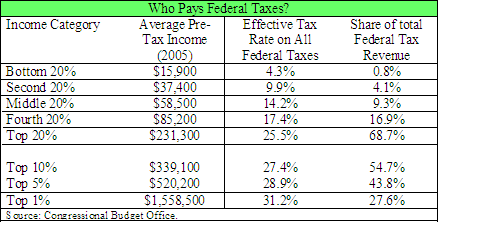
Alex Tabarrok at Marginal Revolution recently calculated the total percentage of all federal taxes (payroll, corporate & excise) paid by various income groups, according to the CBO.
Here are the results:
January 12, 2008
What Passing Bells...
...for these who die as cattle?
Laban Tall is a brilliant English blogger who specializes in chronicling the descent of his nation, once famous for civility, into violence and depravity, under the aegis of a criminal justice system that consistently puts the rights of offenders before those of victims.
Here is a recent report (he is quoting others):
January 14, 2008
Why Our Distributism Debates Are Not Exercises in Romanticism
(Note: Linked Website Contains Profanity)
While there is some justice to the observation that Chesterton romanticized the medieval peasantry - though even this observation can be, and has been, overstated - the notion that economic decentralization and its logical correlate, political decentralization, (whether one wishes to refer to this as old-fashioned American federalism, or, more philosophically, subsidiarity) are exercises in wild-eyed, Jacobinical romanticism is - to put a blunt point on the matter - nonsensical. While I've scant interest in unfolding a lengthy disquisition on the inviability of proposed energy alternatives, suffice it to state that the beginning of the end of the Era of Cheap Energy, with all that cheap energy has made possible, is nigh upon us, if it has not yet dawned. Globalization itself, though it manifestly presupposes cheap energy, promises a steady increase in the costs of energy, and has already occasioned the weakening of Big Oil as a geopolitical force; declining reserves, and the strategic nature of such resources, have precipitated a renewed movement to declare such resources 'strategic', and to shepherd them as forms of sovereign wealth, as opposed to commodities to be auctioned off to multinationals. Even, that is to state, if Peak Oil has not yet come to pass - though it must, in time, if it has not already - there will be exerted a steady upward pressure on energy prices; recessions may develop, but the economies of the world are predicated upon ceaseless expansion, meaning that anything necessary will be undertaken to stimulate Growth, that god of the age. And Growth demands energy; and energy is finite, and certainly only renewable at levels far below the plenitude to which we have become accustomed, and on the presupposition of which our societies constructed.
Herewith, therefore, James Kunstler on the absurdity of our growth-economy and its consequences:
A reader sent me a passle of recent clippings last week from the Atlanta Journal-Constitution. It contained one story after another about the perceived need to build more highways in order to maintain "economic growth" (and incidentally about the "foolishness" of public transit). I understood that to mean the need to keep the suburban development system going, since that has been the real main source of the Sunbelt's prosperity the past 60-odd years. They cannot imagine an economy that is based on anything besides new subdivisions, freeway extensions, new car sales, and Nascar spectacles. The Sunbelt, therefore, will be ground-zero for all the disappointment emanating from this cultural disaster, and probably also ground-zero for the political mischief that will ensue from lost fortunes and crushed hopes.
Continue reading "Why Our Distributism Debates Are Not Exercises in Romanticism" »
January 15, 2008
The defiance we need, and the oppression we've got.
It is my firm view that the most vital problem of American national security, the question upon which hinges our fortune in the war that came to our shores on September 11, in short, nothing less than the most pressing issue before the Republic, is whether or not we will comprehend the ineradicably Islamic character of the enemy.
Are we or are we not a people capable of embracing hard truth about the war that is made against us — the hard truth that the enemy finds his motivation, his inspiration, his justification, his rhetoric, even his strategy and tactics, in the authentic and primitive traditions of the religion of Muhammad? Are we or are we not a people possessed of the fortitude equal to this challenge? As the cliché goes, can we handle the truth?
It is an open question, I’m afraid; and I am convinced that it is one whose answer will tell for or against this Republic for generations for come.
It is in this context that we ought to read with alarm and indignation of the dismissal of Major Stephen Coughlin from the Pentagon. Coughlin worked as a counterterrorism analyst, and took an unsparing view of the Jihad. The document he authored concludes that a “working threat model” of the enemy must begin with “an unconstrained, undelegated, systematic, factual analysis of the threat doctrine that the enemy self-identifies as being driven by Islamic law.” The pulverizing fact is that our current model begins with an unthinking rejection of such analysis: it begins with a deliberate closing of the mind, enforced by the standard methods of intimidation and vilification. Coughlin, for instance, has been publicly castigated as a “Christian zealot with a pen.”
Continue reading "The defiance we need, and the oppression we've got." »
Elizabeth Goudge's novels
 Elizabeth Goudge is a novelist I wish to recommend without exaggerating in either direction. While her novels vary widely, almost wildly, in literary quality, I have found several of them to be not only enjoyable but also spiritually valuable. They are no longer in print, but I stumbled upon her on the shelves of my local public library and was able to get the rest of her books through interlibrary loan. Of course, now I own my favorites as well as Goudge's autobiography.
Goudge’s three best novels, in my opinion, are The Dean’s Watch, The White Witch, and The Scent of Water.
January 17, 2008
The Obama Exception
On the 2nd of February, 2000, George W. Bush gave a speech at Bob Jones University.
According to Wikipedia, it was just "a standard stump speech making no specific reference to the University."
But, at that time, Bob Jones University banned interracial dating. So, because he gave a speech there, George W. Bush was widely denounced by his political opponents for, at the very least, racial "insensitivity" - if not for actual racism. To this day, the event is constantly brought up by people on the left as a prime example of the Republican Party's so-called "Southern strategy" - i.e., it's wicked and cynical attempt to appeal to white racists through symbolic gestures, without actually endorsing their views publicly and explicitly.
Charity, Particularity, and Justice
One of the interesting dialectical pivot points in recent discussions we've had about employment discrimination is charity. At some point our Christian culture degenerated to the point where "charity" started to mean "acts which are nice to do but always optional". Another thing which seems to have come along for the ride is that charity has become more abstract: the notion seems to be that charity is a marketplace selection of opportunities from which we can arbitrarily choose what we want.
In the discussion on natural obligations employers have toward the men providing for families who work for them, this has manifested in two ways.
The first way has been to treat the contingent obligation an employer has to provide for the basic dignity and needs of employees, and in turn the loyalty and diligence that an employee owes to his employer, as optional: as things not required as a matter of reciprocal justice, but rather as gratuitous and completely optional gifts.
The second way this notion has manifested itself is in the idea that charity (and therefore justice) is fungible: that there is no particular charitable obligation of employer to employee in justice but rather that the employer's obligation is just to some abstract charity-in-general, an obligation (to the extent it is one at all: see the previous point) which can be discharged by giving to one of any number of charitable opportunities in a marketplace of opportunities.
January 19, 2008
Homeschooling Heads Up
Those interested in the homeschooling movement - and everybody should be interested in the homeschooling movement! - will want to read this interesting post by Alan Jacobs at The American Scene: "Confessions of a Christian Homeschooler".
Jacobs comes across as very reluctant convert, who really wants to remain faithful to the public schools. But a convert he is. Here's a quote:
January 21, 2008
Should Christian virgins be vying for sex-object status?
Since I have no TV channels (just a box that works with the VCR) and have never seen "American Idol," I may have little right to comment on this story, but I thought it a kind of interesting one.
It seems that a young man named Bruce Dickson, age 19, a home-schooled Christian who has promised not to kiss a girl until his wedding night, wants to be a singer. So he competed (or whatever it is you do) on "American Idol," and got himself mocked by the folks in charge there for "not being a man." There's no comment in the story on how good his singing was.
Continue reading "Should Christian virgins be vying for sex-object status?" »
January 22, 2008
Inane Liberal (?) (Im)Pieties
One day last week, while running a number of errands on a day away from the office - the state of PA neglected to send us a renewal form for my wife's driver's license, and, on top of that, her mobile phone was pilfered - I noticed a bumper sticker new to me, printed in that semi-florid script which usually distinguishes vacuous new-agey pseudo-profundities. The text, which I have not been able to locate on the internet, read, in what is at least a passable paraphrase, "The blessing of life lies in the consciousness of the blessing."
January 23, 2008
Are Intrinsic Injustices Becoming Litmus Tests on the Right?
One exhibit among many in such an inquest might be James Bowman's American Spectator essay lambasting John McCain as a man lacking in the loyalty department. While I'm scarcely a fan of John McCain, the ambitious politician, questioning his loyalty and, by necessary implication, as loyalty is a component of honour, his integrity as well, strikes me as desperate and desperately misguided.
In context, the accusation is even worse:
But there are other parts of his record that bring him closer to the news media and (not, of course, coincidentally) the Democratic Party's presidential candidates in his understanding of honor. For such people, as Mr. Stephens says, "if it means anything at all to them, it seems to be mainly in the sense of the good opinion of America's traditional friends, many of whom opposed the Iraq venture from the start."As an example, I would mention the countenance and the credibility that the senator's animadversions on "torture" by the Bush administration give to America's enemies, for whom the t-word is an invaluable propaganda tool. An essential element of honor has always been loyalty, and loyalty has never been Senator McCain's strongest suit. Rather, he has always been proud of being a "maverick" -- a man who likes to be thought of as one whose friends and comrades are less important to him than his own exquisite conscience.
Continue reading "Are Intrinsic Injustices Becoming Litmus Tests on the Right?" »
Understanding Liberal Fascism
Jonah Goldberg's recently-published tome, Liberal Fascism, has, as one might imagine given the incendiary title, generated much controversy, much of which can be digested, albeit from its author's perspective, over at the liberal fascism blog at National Review Online. Intrigued by the authorial intention of disclosing the affinities of certain strands of progressivism with darker ideological shades, not to mention the essential leftism of fascist ideology, a theme dear to the heart of every conservative who has ever assimilated Erik von Kuehnelt-Leddihn's Leftism Revisited, I purchased a copy with every intention of settling in for a painstaking reading, provided only that initial impressions did not confirm my suspicions.
Alas, reading the dust jacket and perusing the contents and index, followed by a spell or two of unsystematic browsing, only confirmed my initial suspicions: Goldberg employs, not merely a generic typology of fascism, but a typology so diffuse, indistinct, and indiscriminate that the apparent operational logic associates things with fascism merely because real, historical fascists may have said/done/advocated/liked similar things. No end of analytical mischief results from such imprecision; illustrative of the dynamic might be the association of organic foods and vegetarianism with fascism, merely on the grounds that actual fascists occasionally manifested an interest in such things. That things possess a distinct essence or nature, and that these things can be situated in radically different social and theoretical contexts, depending upon the narrative framework within which they acquire collective meaning, are considerations altogether too nuanced for Goldberg's labours. Those labours indeed seem to involve piling together a veritable mountain of things of which the author disapproves, on the basis of a few superficial resemblances - not even family resemblances, necessarily - which suggests the conclusion that they are substantively similar - except that Goldberg often shrinks from this conclusion. He'll intimate that something is hinky, aver that he's not really saying that anything is hinky, and leave the reader with the nonrational sense that that something is just off. A shrewd rhetorical performance, to be certain, though not a style commensurate with the gravity of the subject matter.
Apropos of this methodological inadequacy, James Poulos, following upon Austin Bramwell's decimating review of Liberal Fascism, suggests that Goldberg is engaged in a thoroughly postmodern performance, one that threatens to evacuate authority from the conversation:
Jihad in Atlanta
I commend to your attention a Jan. 20th story in the Atlanta Journal-Constitution headlined, “Muslim cop played key role in terror probe.” The tale told is fairly simple: a DeKalb County detective of Islamic faith and heritage, Mr. Khaled Sediqi, along with his partner, investigated and ultimately apprehended an agent of the Jihad. DeKalb splits the city of Atlanta with the more well-known Fulton County; both the detective and the Jihadist attended the same mosque in Midtown near Georgia Tech. Syed Haris Ahmed, a former student there, is to stand trial for material support of a terrorist organization. He and an accomplice were arrested in 2006 and, later in that year, officially linked to a much larger Jihadist cell out of Toronto.
There is drama in abundance here. The detectives nearly succeeded, it appears, in turning Ahmed into an intelligence asset; he later changed his mind, having fortified himself “through prayer,” according to the article, and warned his accomplice. The interrogation technique of Mr. Sediqi, who we are told played the consummate “good cop” to his partner’s more aggressive and demonstrative method, seems to have relied at least partly on direct theological confrontation: “When you say you’re a good Muslim … I believe you, man” but “you’re easily swayed,” by men “with some really evil ways and evil ideas.” “If you’re trying to hurt innocent civilians and unarmed people, then you’re no longer a Muslim.”
Let us hope that the detective has, on Islamic grounds, the better argument here. We know that, on grounds of truth, he has the better argument. The principles and traditions of the Jihad are “evil ways and evil ideas.” If a man is truly “no longer a Muslim” when he embraces them, well and good. If he is rather a true Muslim . . . well, so be it.
But that conundrum we still have the luxury of leaving aside. We the people of the Republic are not now obligated, in my judgment, to deliver our republican judgment on the character of the Islamic religion. Many of us knew little about Islam before a certain autumn raid. And it would be a terrible thing for a republic to be forced to give a yea or nay vote on a whole religion and civilization. History is littered with the husks of great kingdoms and peoples, first savaged by the Jihad, then corrupted and enervated by the demands of a defense against it. The Empires of Byzantium and Spain, each in their characteristic way, teach this bitter lesson.
I call it a blessing that it is still within out power, as I perceive, to check the enemy and baffle his plans, here on our shores; to reduce our intercourse and limit our exposure to his madness; to crush his doctrine, his method, his conspiracies; to extirpate from our land the tendrils of the Jihad, and do so without war and repression — this is not yet beyond our power.
So we may still stay our judgment of Islam. But by God it is long past time that we delivered a resounding negative on the doctrine and institution of Jihad: wicked, treasonable, and menacing.
Detective Sediqi, I salute you — as an Atlantan, a Georgian and an American.
January 24, 2008
The Wages of Debt and Speculation
In recent weeks, observers of left and right have been expressing great consternation over the increasing penetration of American capitalism by foreign sovereign wealth funds, which in a few notable instances, have ridden to the rescue of American financial institutions enfeebled by various exotic forms of speculation, which, for that matter, ought to be distinguished from responsible investing. A partial tally, given by Andrew Leonard in a piece in Salon, reads as follows:
# Citigroup: $7.5 billion from Abu Dhabi Investment Authority and $6.88 billion from Government Investment Corp. of Singapore.# Morgan Stanley: $5 billion from China Investment Corp.
# Merrill-Lynch: $5 billion from Singapore's Temasek Holdings, $6.5 from Kuwait Investment Authority, $2 billion from Korean Investment Corp.
# Bear Stearns: $1 billion from China Investment Corp.
# UBS: $10 billion from the Government Investment Corp. of Singapore.
Leonard discusses the successive bouts of hand-wringing and whining that have accompanied this emerging trend, most poignantly the distraught complaint that ill winds are sweeping away the momentous economic transformations inaugurated by Reagan and Thatcher, and observes that
Perhaps it would be more accurate to say freer markets lost the day. The root of Wall Street's woes leads back directly to their own strategic missteps, greed, speculation-run-amok, and lack of appropriate supervision. The brightest minds in finance had exactly what they wanted, a playground where the monitors were looking the other way, and they blew it. When the China Investment Corp. pumps in $5 billion to Morgan Stanley, we are not witnessing the triumph of state capitalism, but rather, the embarrassing, humiliating failure of Reagan-Thatcher style unregulated capitalism. So now the U.S. buys Chinese toys at Wal-Mart, and China uses the resulting cash to buy American banks. Hey, anything's fair in love and war and free markets.
Choice devours itself--again
No doubt all in my audience will remember the passage in Slouching Towards Gomorrah where Robert Bork tells about walking down the hall during the Anita Hill hearings and saying to Irving Kristol, "They're showing the end of Western civilization on television."
Well, here's another moment rather like that: Dawn Eden links to a Planned Parenthood worker, a blogger, who openly admits that she provided birth control pills for a 12-year-old girl whom the blogger suspects is being coerced into sexual intercourse by a man much older than herself. And not reporting it, of course, to any authorities, despite the fact that such a "health worker" is legally a mandatory reporter of child abuse.
January 28, 2008
The Iconography of Late Liberalism
Each society, having attained an indeterminate, though critical degree of sophistication, develops and elaborates characteristic modes of aesthetic expression. In healthy, integral societies, these modes are disseminated throughout; though there may be higher and lower expressions of these forms - as with the relationship of classical music to various folk traditions. Seen under another aspect, these aesthetic forms are not separate from life; they do not confront members of a healthy civilization as an otherness to which one repairs in order to escape from a discontinuous and ostensibly hideous and impoverished reality. Art may express the sense of the transcendent - indeed, it cannot but do this on some level - but it is not regarded as salvific.
Hence, each society develops an implicit iconography, a series of images, tropes, and forms which constitute a sort of natural sacred, which disclose in sensory forms the religious ethos of that society. Without words, these may direct even the unlettered as to what, and to whom, reverence is owed. Communist societies, such as the Soviet Union of my wife's youth, for example, merely substituted for icons of Christ, the Mother of God, and the saints images of communist personages; and one might even suggest that socialist realism developed a sort of cycle of images, an obvious analogue and replacement for cycles of sacred images. Constructivism added further grotesqueries to the iconography of communist society, and socialist realism itself easily descended from the heights of hagiographic excess to the bathos of simple propaganda. And this is not to slight the monumental sculpture of communism, which, in its brutal modernism, perfectly embodied the essential inhumanity and violence of communism, theory and practice.
January 29, 2008
Liberal Fascism, Revisited
Reader Deuce has posted an interesting comment in the earlier Liberal Fascism thread, one which, in my judgment, merits a more substantial response.
I begin by noting that, in the original entry, I wrote the following:
That things possess a distinct essence or nature, and that these things can be situated in radically different social and theoretical contexts, depending upon the narrative framework within which they acquire collective meaning, are considerations altogether too nuanced for Goldberg's labours.
The significance of this remark is simply that particular ideas or social practices, even if they may be regarded as possessing some sort of transhistorical essences, acquire meaning only within determinate social, economic, and political contexts. It is, in consequence, insufficient to observe that, to continue the illustration, fascists often evinced a concern for health and organic foods, contemporary liberals do the same, and both were/are willing to police individual conduct (or at least engage in moralizing discourses to this effect) in order to ensure that the common good in this area of existence is respected, deriving the conclusion that both fascism and liberalism share an ideological lineage. Narratives matter.
January 30, 2008
Hail Caesar! We Who Are Now Subjects Salute You!
Via Rod Dreher, Charlie Savage's latest report on the Bush administration's imperial fetish for signing statements. Apparently, The Decider felt that the strictures of the latest defense authorization act (or whatever term is used to designate those things) impugned the sovereign majesty of his office, and so issued the now de rigeur signing statements expressing his own judgment as to the permissible contours of the law. Law, despite what one may believe - and I pause to note Willmoore Kendall's position that the Constitution creates a system of legislative supremacy, if only the Congress would use it - only becomes law when the executive deems it law. It is the universalization and inversion of Carl Schmidt's theory of sovereignty: no longer is the sovereign he who decides upon the exception, the unusual, chaotic disruption of normal politics; instead, sovereign is he who decides that anything can be an exception - and gets away with it.
Rod writes:
Specifically, Bush has said he won't be bound by provisions in the Defense bill he signed forbidding the expenditure of funds to build permanent bases in Iraq. He also said he won't be bound by Congress's direction that the US is not to control Iraq's oil. Moreover, he has reserved the right not to act on other provisions of the law that would mandate establishing a commission to investigate waste, fraud and abuse in military contracts, as well as another to strengthen whistle-blower protection. Finally, he reserves the right to decide whether or not he's going to enforce a requirement that the president explain in writing when intelligence agencies refuse to provide documents to the two armed services committees in Congress.
So you thought that future Congresses might have the authority to, you know, bring the troops home? Not so! The Decider may negotiate some sort of pact with the Iraqi government, something more than a policy but less than a treaty (otherwise Congress would have to ratify it), creating circumstances under which the troops will be there indefinitely. And you might have thought that oil had nothing to do with American policy in the region. Ha! Instead, The Decider now arrogates to himself the authority to put truth to the talking points of the left and the paleo right. You might have thought, moreover, that waste, fraud and abuse, particularly in a military-industrial establishment rife with corruption - not to mention profitable revolving doors between the bureaucracies, advisory panels, and boardrooms of connected corporations - should be investigated. Perhaps not. Finally, you might have thought that the whole 'checks and balances' thing should apply to the formulation of foreign policy, intelligence agency conduct (particularly given the torture scandals). But, really, how naive! We cannot have, oh, say, the rule of law when we are confronted with the perpetual emergency - why, that might be indicative of a lack of faith, and we are speaking of Those Who Must be Trusted.
I know that it might be said that my comments are uncharitable and offered in a derisive tone. To this, all I can state is that I'd owe charity to a president, but not a quasi-emperor, of whose pretensions I can only speak derisively.
January 31, 2008
Rousseau Was Wrong. Is Anyone Surprised?
I wanted to blog this, despite not having much to add by way of commentary:
Most of us know, now, that Rousseau was wrong: that man, when you knock his chains off, sets up the death camps. Soon we will know everything the eighteenth century didn’t know, and nothing it did, and it will be hard to live with us.—Randall Jarrell (HT: Nicholas Desai, at The American Scene.)
Emancipation from the moral and religious heritage of Christendom + Technological emancipation from natural limitations (and from nature understood as intrinsically, as opposed to instrumentally, teleological) = The abattoir (inclusive of everything from the Holocaust to the Gulag to the privatized holocausts of the American superman (and superwoman). Fine; I've expanded upon the original, but I'd proffer this as the elementary equation of political modernism.
Economic Karma
Patrick Deneen has posted an intriguing analysis of the walk-away culture emerging in the wreckage of the collapse of the mortgage debt pyramid. Referencing this article on the new business of 'walking away', which discusses the rising trend and summarizes the animating ethos thusly:
If banks can make "business decisions" to ignore risks, to lend money with no down payment, and fire people at at the first sign of trouble without any remorse, why shouldn't consumers be able to do the same?
Deneen explicates the broader sociological context of the phenomenon, namely, the negation of the preconditions of a societal sense of shame:
What Globalization Means, Revisited
By way of explaining what is undoubtedly perceived as my peculiar antipathy for globalization and the economic doctrines taken to undergird it, allow me to present economist Dani Rodrik's trilemma of the global economy (there is even a chart at the link):
I have an "impossibility theorem" for the global economy that is like that. It says that democracy, national sovereignty and global economic integration are mutually incompatible: we can combine any two of the three, but never have all three simultaneously and in full. (Snip)To see why this makes sense, note that deep economic integration requires that we eliminate all transaction costs traders and financiers face in their cross-border dealings. Nation-states are a fundamental source of such transaction costs. They generate sovereign risk, create regulatory discontinuities at the border, prevent global regulation and supervision of financial intermediaries, and render a global lender of last resort a hopeless dream. (Snip)
One option is to go for global federalism, where we align the scope of (democratic) politics with the scope of global markets. Realistically, though, this is something that cannot be done at a global scale. It is pretty difficult to achieve even among a relatively like-minded and similar countries, as the experience of the EU demonstrates.
Another option is maintain the nation state, but to make it responsive only to the needs of the international economy. This would be a state that would pursue global economic integration at the expense of other domestic objectives. The nineteenth century gold standard provides a historical example of this kind of a state. The collapse of the Argentine convertibility experiment of the 1990s provides a contemporary illustration of its inherent incompatibility with democracy.
Finally, we can downgrade our ambitions with respect to how much international economic integration we can (or should) achieve. So we go for a limited version of globalization, which is what the post-war Bretton Woods regime was about (with its capital controls and limited trade liberalization). It has unfortunately become a victim of its own success. We have forgotten the compromise embedded in that system, and which was the source of its success.
The logic of regulatory and legal harmonization entails a narrowing of political distinctions, the endpoint of which is suggested by the European Union. However, under such a regime, the fundamental symbols of representative politics will become, first, abstracted into generality and ambiguity, so as to encompass widely divergent societies; and, second, rendered equivocal, meaning one thing for one people and another thing for a different people. While his conception of representative politics encompasses such entities as global trade unions, this is, more or less, the upshot of Jeff Faux's policy programme for a globalist democracy. Obviously, this will not work.
American policy seems to instantiate the worst of both words, with incremental integration structured so as to benefit a comparatively narrow socio-economic stratum, and an establishment political consensus that constrains viable domestic political responses.
Whatever the case may be, globalization is subverting both the integrity of the nation-state and the quality of the representative politics within the nation-state - and the nation-state is the only contemporarily viable vehicle for any sort of conservative politics. If we lose that, we lose the whole game.